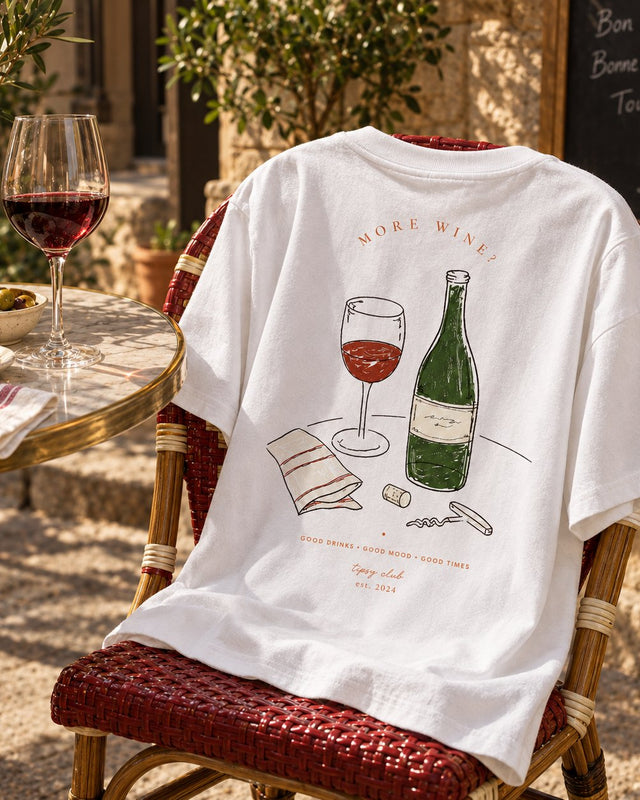
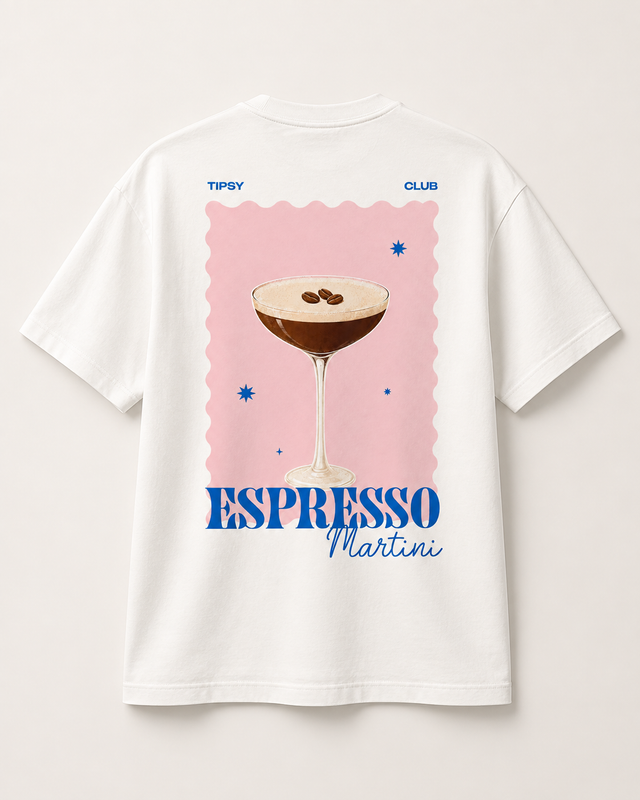
The anatomy of a TIPSY. back print
From a recognisable drink to a print that survives cotton, movement and the distance between two tables.
A cocktail already has a structure: ingredients, proportions, glass, garnish, place and memory. Turning one into a back print is an exercise in editing.
Start with the drink, not a moodboard
The first question is what makes the drink recognisable from across a room. For a gin and tonic it might be the highball, bubbles and cut citrus. For a martini, the silhouette of the glass does much of the work. The design begins with those signals before typography or ornament arrives.
Draw for cotton
An image that looks sharp on a lit screen can lose itself on fabric. Lines need enough weight, small gaps need room and the composition needs to survive movement, folds and the distance between two tables. We simplify deliberately, keeping the marks that carry character.
Negative space matters just as much. It lets the cotton become part of the image and stops the print from behaving like a rectangular poster glued to the back.
Give the words a job
Text can name the drink, carry the recipe or add a house phrase, but it cannot all shout at once. TIPSY. uses a clear hierarchy: the drink first, supporting information second, the club signature last. The back should read quickly and reward a closer look.
Front restraint, back story: the chest mark introduces the club; the illustrated plate earns the space behind it.
Test the full object
A print is not finished when the artwork file is finished. It needs to be placed at real size on the garment, checked against seams and neckline, and viewed on a moving body. Only then does the plate belong to the tee rather than merely sitting on it.
See the drinks in The Bar Book.
01. A French inheritance.
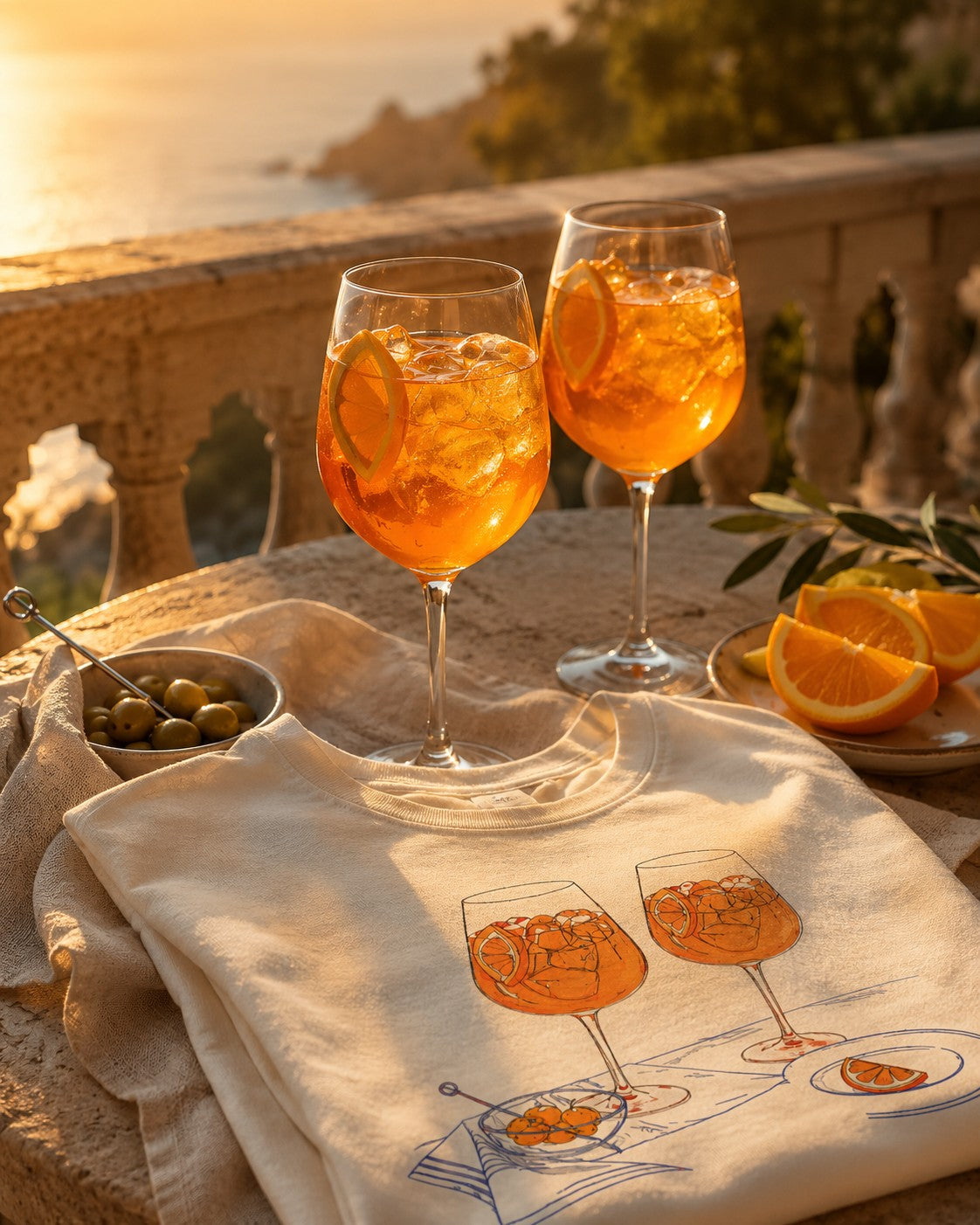
From Marseille to Biarritz, from Paris to Saint-Tropez, the apéro is part of everyday life. More than a habit, it is a shared language: the one of passing things around.
No special occasion needed. Open a bottle, put a few good things on the table, and let the evening take its time.

02. Simple things, long evenings.
A good apéro asks for very little: things worth eating, people worth seeing, and the time to enjoy both.
Olives, cheese, grilled vegetables, good bread, olive oil and a pinch of sea salt. The rest is up to the evening.
The secret of a good apéro is not to overthink it.
An apéro is not just a moment. It is a state of mind.

03. Summer, obviously.
When the days grow longer, outside starts calling. Terraces, beaches, quiet coves and dinners under the stars.
This is the season of apéros that run late, of the people you meet along the way, and of the evenings you keep.